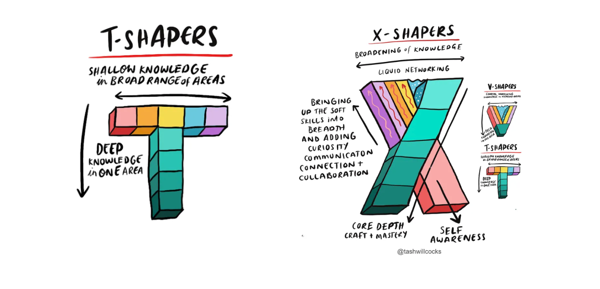
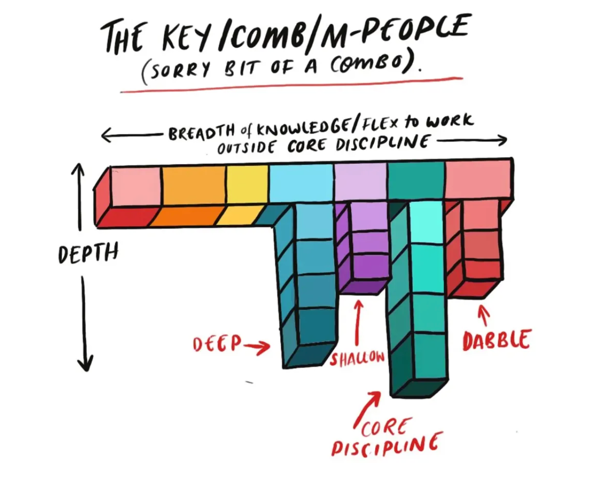
In our Research and Analysis team, we have been looking at the soft edges between design disciplines. Within the government digital and data (DDaT) framework, it can become easy for roles to become siloed. But the reality of solving complex public sector problems is that most people are X, T or key shaped. They have a deep home craft, alongside adjacent skills that make them better collaborators.
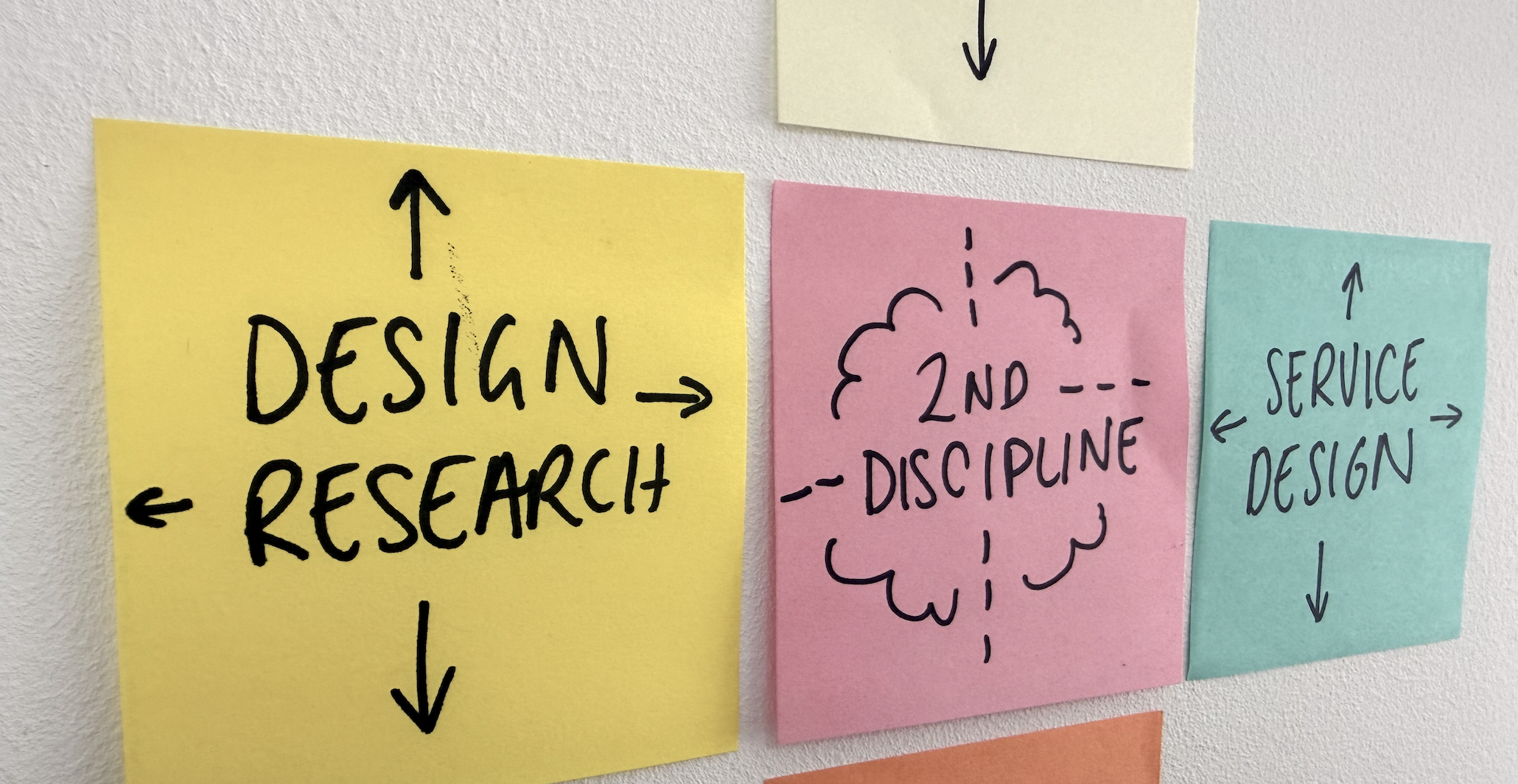
We have been experimenting with a structured way to grow those adjacent skills. We call it the second discipline.
To bring this to life, our Head of Learning Design, Tash Willcocks, sat down with our Head of Design Research, Imeh Akpan, who has been leading how we pilot this model
Where we started and why
Tash: What is the second discipline to you, and why did we create it?
Imeh: I could see talented people in other design roles who were keen to pick up research activities, but we needed a safe, structured way to do that. We had to ask: what type of research are we comfortable for another role to do? What evidence gives us confidence they can do it to the right standard?
The second discipline gives people a pathway to grow competence, confidence, and judgment in a new area, without pretending they are instantly at specialist level.
Tash: I love that framing because it respects the craft while opening the door. It is not about everyone doing research. It is about some research being learned through structure, coaching, and clear limits.
UX research versus design research
Imeh: It helps to clarify what we mean by research. Traditional UX research often centres on web-based interactions, like usability testing, surveys, and interviews to optimise digital products.
But we also design complex policies, end-to-end services, and business change strategies. This requires exploring deep social and organisational problems, often involving sensitive topics. Here, methods must be carefully tailored, drawing on psychology, anthropology, and cognitive science. That requires specialist expertise.
How the structure works
Imeh: We start with an assessment against a concise skills framework for entry-level UX research, covering basic usability testing, analysis, and inclusive practice. Individuals self-score, and then a senior researcher holds an open conversation to map out growth areas.
Support comes in two flavours, baked directly into project delivery:
-
Alongside a project: A senior researcher leads, and the learner co-researches with active coaching.
-
Independent with review: The learner runs agreed activities, checking in weekly with a senior buddy for peer support and feedback.
Tash: That business as usual point matters. When coaching is invisible, it relies on personal goodwill and eventually breaks. When it is planned into delivery, it sustainably builds capability.
Breaking down silos
Tash: What changes when disciplines overlap like this?
Imeh: A huge side effect is empathy. People think they understand another role until they see the layers underneath. When content designers shadowed research, they realised how much rigour and admin sit behind a few interviews. Respect rises, handovers get cleaner, and siloed talk softens.
Tash: There is a risk that a second discipline just becomes a queue of admin tasks and note-taking. That isn't capability building, it is extraction.
Imeh: Exactly. That is why we define methods, not chores. You learn to plan, analyse, and reflect with clear sign-off points. You start with low-risk UX work, moving later toward qualitative studies. Everyone learns when to stop and call in a specialist.
Tash: Plus, the self-awareness to say, 'I can help here' or 'I need to step back.' That humility is a safety net.
Intentional support structure
Tash: Many public sector teams don’t have a full DDaT orchestra. They have Maeve, who is great at interaction design, and not much of a team around them. When Maeve is designing and running research on her own work, it is very human to ask leading questions or see what you expect to see, it’s where I feel bias leaks in.
Imeh: Second discipline models offer a grounded way through this. Instead of asking Maeve to do everything, you create small, intentional pairings, perhaps with other Maeves in similar positions, who can run research for each other. It brings fresh eyes and reduces bias without needing a fully staffed specialist team.
Where AI fits
Imeh: AI will compress entry-level learning. A learner could draft a research plan, ask AI to critique it, and learn from the reasoning. Researchers can then step in where judgment, ethics, and human context are critical, freeing them up to coach.
Tash: The trick I think will be using the time AI gives back to think better, rather than simply cramming in more tasks.
What success looks like
Imeh: Continuous learning. People might grow research skills this year, and a different discipline next year. Over time, the research community feels valued because quality is visible, shared, and respected.
Tash: The second discipline isn't about creating mythical design unicorns, that old way worked for no one. It is about growing joined-up capability with care, scoped risk, and clear methods. That is what makes us useful to complex public services.
Want the templates we used for skills assessment and buddying? Get in touch – we would love to keep the conversation going.
More from our design blog
Transformation is for everyone. We love sharing our thoughts, approaches, learning and research all gained from the work we do.
-

Design Research in technical contexts
Read blog post -

How a Neurodiversity ERG builds better teams
Read blog post -
-