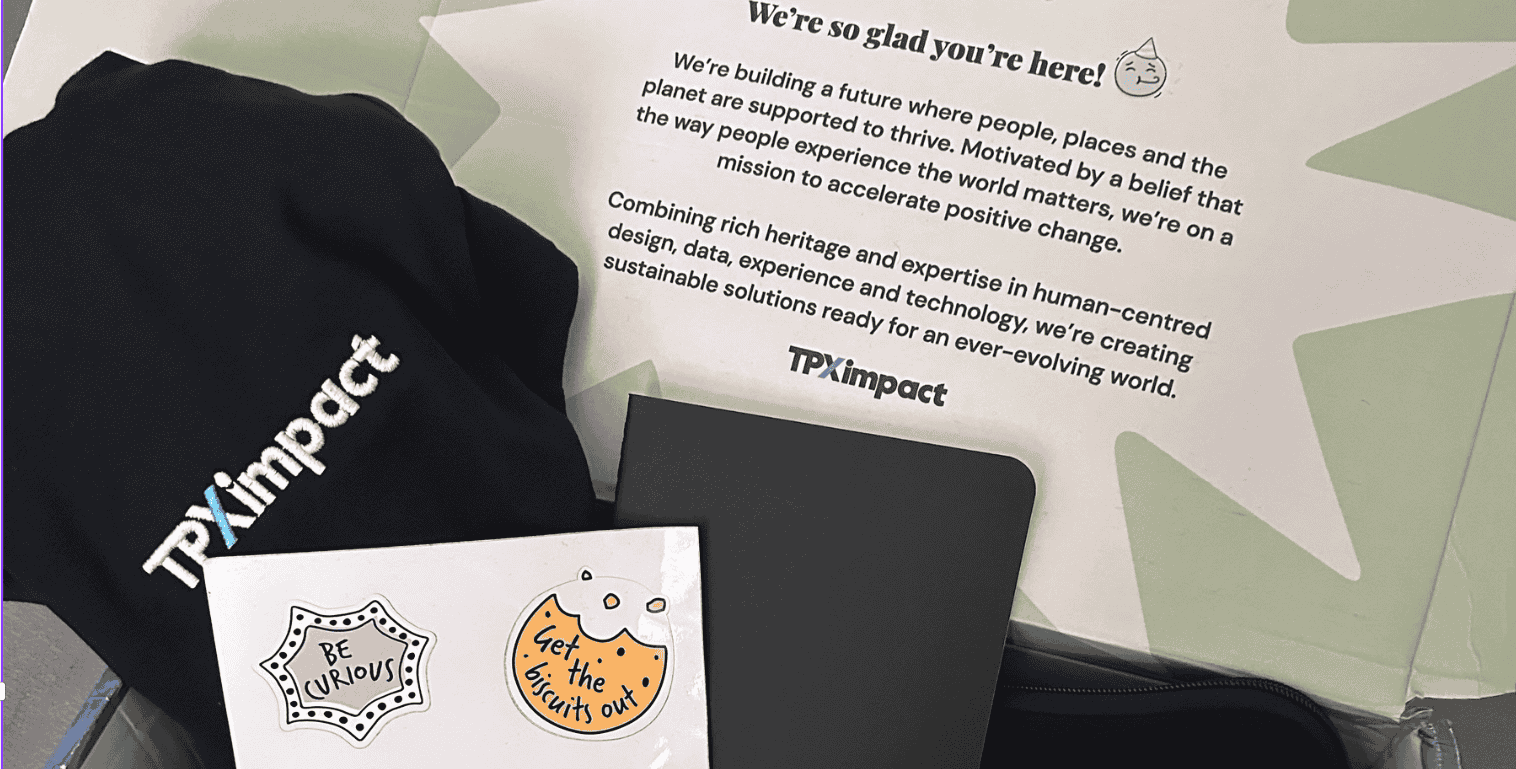
Transitioning into public sector consultancy hasn’t felt like starting over. If anything, it has felt more like reconnecting with the reasons I got into service design in the first place.
Before joining TPXimpact in January, much of my work focused on private sector innovation – future-facing, commercially driven, and often intentionally ambiguous. The pace and complexity are still very much present in consultancy, but the context is different.
Here, the work is grounded much more directly in public outcomes, accessibility, policy, and operational realities. Instead of designing primarily around market opportunities, I’m now working within systems that directly affect people’s lives and, in many ways, it has brought me closer to my roots.
A lot of my academic work at Glasgow School of Art explored healthcare systems, preventative care, participation, and public services. Returning to projects connected to sustainability, education, inclusion, and service transformation has felt surprisingly familiar.
That said, consultancy has definitely come with a learning curve.
Learning a new environment
The biggest adjustment of working for a consultancy has been learning to operate within multidisciplinary delivery teams across multiple client projects – constantly balancing delivery pace, stakeholder management, governance, collaboration, and adapting practice to different organisational cultures.
During my first few months, I’ve supported work which has given me insight into how service design operates within larger public sector ecosystems.
It’s particularly interesting how many competing factors need balancing at once: policy ambitions, operational constraints, delivery realities, and people’s lived experiences. Good design in this space is rarely linear or straightforward.
A major shift has been recognising that consultancy is less about having all the answers and more about creating alignment across different forms of expertise. Coming from innovation environments where roles were blended, I’ve appreciated the depth of craft within specialist disciplines at TPXimpact, which has pushed me to be more reflective about my own practice and where service design adds the most value amongst teams with the likes of design researchers, product/interaction designers and content designers to name a few.
Bringing previous experience with you
Joining a new organisation doesn’t mean leaving your previous experiences behind.
Over the past few months, I’ve shared some of the tools and approaches I’ve previously used. During a Service and Organisation Design practice session, I facilitated a short personality evaluator activity where colleagues discovered their lead energies on an archetype wheel. This is a useful way of understanding how different people prefer to communicate, collaborate, and approach challenges.
I facilitated a similar session with a project workstream shortly afterwards. In hybrid, fast-moving consultancy, creating those moments of shared understanding makes a huge difference.
Reconnecting with public service design
One thing I’ve particularly enjoyed is reconnecting with public service design approaches and standards like the Government Digital Service (GDS) frameworks.
Public sector service design often requires a different mindset – designing for accessibility from the outset, understanding governance and policy constraints, working transparently across teams, and thinking carefully about long-term sustainability and operational viability.
It’s less about creating polished solutions quickly, and more about building confidence, reducing risk, and improving services iteratively over time.
Community, learning, and belonging
One of the things that genuinely surprised me when joining TPXimpact was how strong the internal learning culture is.
Over the past few months, I’ve benefited hugely from engaging with our Service and Organisation Design practice - whether through presentations, workshops, informal conversations, or simply observing how others approach challenges.
For anyone earlier in their career, especially graduates or people entering consultancy for the first time, this is probably one of the biggest pieces of advice I could give:
Get involved wherever you can. Stay curious. Get involved. Ask questions. And share your work.
Not in a performative ‘always be busy’ sense, but because so much learning happens outside your immediate project work. Those moments build confidence surprisingly quickly, while also making large organisations feel much smaller and more human.
I’ve also become involved with TPXimpact’s Neurodiversity Employee Resource Group (ERG), which our co-chair wrote an amazing blog about recently.
During Neurodiversity Week, I took part as a panellist in an internal fireside chat discussing workplace accommodations and support, and talked about my own experience, sharing my reasonable adjustments form outlining the adjustments I need to work at my best.
There can often be an unspoken pressure in professional environments to ‘settle in first’ before asking for support. What has stood out to me here was how normalised these conversations are, rather than being treated as exceptions. That creates a very different kind of culture – one where people feel included and able to belong.
Closing thoughts
There’s still a huge amount I want to learn – particularly around public sector delivery, and continuing to develop my service design practice.
But overall, my transition into consultancy at TPXimpact has been an incredibly positive experience.
More than anything, it has reminded me that good design rarely happens in isolation. It happens through collaboration, curiosity, openness, and a willingness to continually learn from the people around you.
If you're interested in joining us, take a look at our open roles.
More from our design blog
Transformation is for everyone. We love sharing our thoughts, approaches, learning and research all gained from the work we do.
-
The tide is changing for in-field observational research
Read blog post -

How AI agents will change the role of your website
Read blog post -

Thinking in pictures with visual facilitation
Read blog post -
Building visualisations that adapt
Read blog post
